MEET THE SET BUILDERS!!! If you’d like to see the finished product come and see the UNFRIEND or if you’d like to join our team in future please contact us.
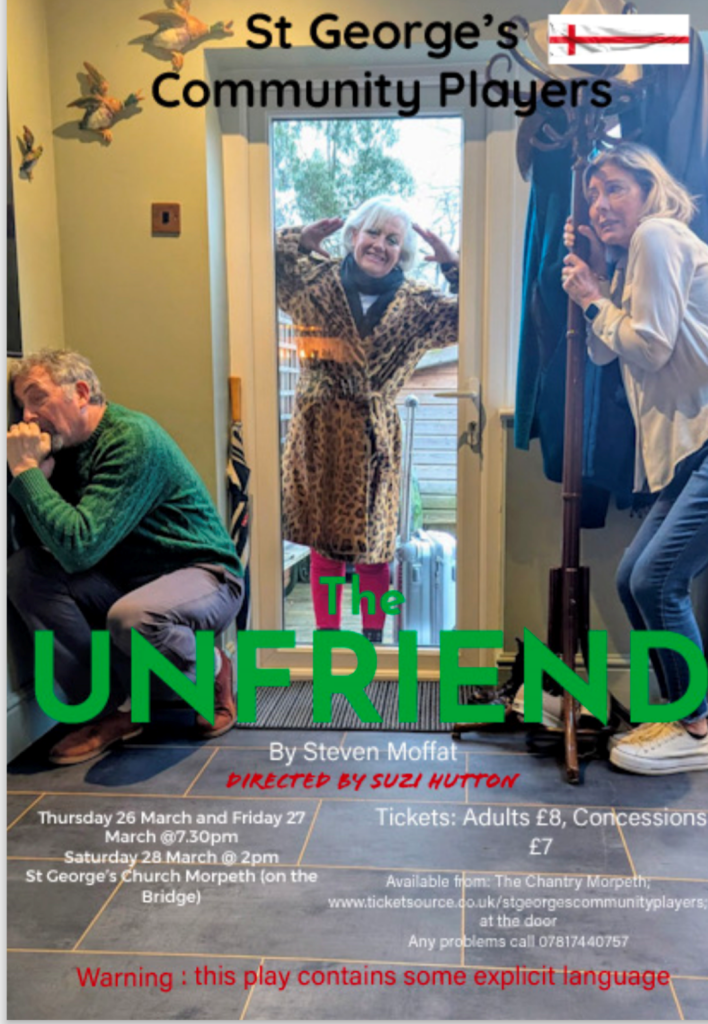
The Unfriended – By Steven Moffat – Directed By Suzi Hutton
Thursday 26th March, Friday 27th March @ 7:30pm Saturday 28th March @ 2pm
British politeness is a curious thing. It can survive awkward silences, emotional droughts, and even mild existential despair. What it struggles with, as it turns out, is murder.
The Unfriend begins innocently enough. Peter and Debbie Lindel, comfortably middle-class and comfortably stuck, return from a cruise having made what they believe to be a harmless holiday acquaintance. Elsa Jean Krawkoski is American, loud, relentlessly friendly, and keen to visit. Saying no would be rude. Saying yes feels… inevitable.
When Elsa arrives, politeness is tested, stretched, and eventually throttled. A quick Google search reveals that their guest may not just be socially overwhelming but genuinely dangerous. What follows is a deliciously escalating farce in which social niceties clash with self-preservation, and the British instinct to avoid embarrassment proves far stronger than logic, morality, or common sense.
Complicating matters further is the Lindels’ unendingly dull neighbour (Robin Heron), whose casual disregard for boundaries extends from conversation into the garden itself. A seemingly trivial dispute over hedges and territory becomes another exquisitely awkward pressure point, proving that in middle-class Britain nothing is more dangerous than a shared fence line and too much time to talk about it.
Adding to the chaos is PC Junkin (Charlie Tomson), an affable local policeman whose professional instincts are somewhat dulled by his personal fascination with Elsa. His presence brings reassurance of the law, while simultaneously removing any confidence that it might actually help.
At a key point, the audience will see a live Breaking News broadcast from newscaster (Bridget Rowbottom), from Denver, USA, running alongside the frozen domestic scene.
Stephen Moffat’s comedy skewers the quiet terror of confrontation. The fear of saying the wrong thing. The dread of appearing impolite. The absurd lengths we go to in order to keep the peace, even when the peace is very clearly armed.
This play appealed to me because beneath the laughter is something sharply recognisable. We have all, at some point, smiled through discomfort, nodded along when we should have screamed, or hosted something we desperately wanted to cancel. The Unfriend simply asks: how far would you take that impulse?
As a director, my focus has been on truth within the chaos. The comedy only works if the relationships feel real and the stakes feel human. Elsa is not a cartoon. The Lindels are not fools. Everyone is doing their best with the tools they have, which makes their collective collapse all the more entertaining.
I have been supremely impressed by the work of our three central performers. Sharon Lamont (Debbie Lindel), Alan Bullock (Peter Lindel), and the inimitable Charlotte Ridley (Elsa Jean Krawkoski) have embraced the ferocious pace and precision of Moffat’s writing with extraordinary commitment. To be almost word-perfect a month into rehearsals is astonishing, and their command of character has set the tone for the entire company.
I am also proud to be working with two outstanding young performers in the roles of Rosie and Alex Lindel (Nicole Burrow and Tom Sharp). Their energy, intelligence, and dedication bring a vital heartbeat to the production, and it has been a privilege to support them as they explore their craft with such enthusiasm and ambition.
This is my directing debut after many years treading the boards. Theatre has always been where I feel most alive, even if my memory occasionally has other plans. Stepping into the director’s chair has been both daunting and exhilarating, and I am grateful to St Georges Community Players for the trust, generosity, and humour they have shown throughout this process. I do have the assistance of a seasoned wing woman in the shape of Anne Marie Cairns, who keeps me in check with all details that elude me.
This is a big production requiring a big set build and I think the tech team that will pull this technical production are the best in the business… thanks, in advance tech team!
Performed in a church hall, this production does contain some strong language reflective of modern speech. It is used purposefully, never gratuitously, and always in service of character and comedy. Audience discretion is advised, along with an open mind and a willingness to laugh at ourselves.
We hope you enjoy the show. And if you leave wondering whether you should ever invite anyone round for dinner again… then Moffat has done his job.
Play review: Morpeth St George’s Community Players perform ‘Quartet’ by Ronald Harwood By Brian Bennett – Published 31st Mar 2025
Spanning several decades, Morpeth St George’s Community Players have produced many a comedy on the stage at the Church Hall.
However last week, their spring production ‘Quartet’ by Ronald Harwood, which was wonderfully directed by Sharon Saint Lamont and her assistant Maggie Meigh, must rank as being one of their best ever.
The play – described as beautiful, delightful, funny and touching – centres around four former opera singers who are in a retirement home for ex-musicians and was neither a farce nor a tame offering.
Instead, Harwood reaches out and tries to put into context how life can be challenging and very different in retirement years; “why do we have to grow old” is one prominent line.
From left, Wilfred Owen (played by Karl Bovenizer), Jean Horton (played by Bridget Rowbottom) and Cecily Robson (played by Janet Robinson), Reginald Paget (played by Alan Bullock) pictured during the Quartet performance.
The four leading characters in this show, Janet Robinson (as Cissy), Alan Bullock (as Reggie), Bridget Rowbottom (as Jean) and debutant Karl Bovenizer (as Wilf) – all superb in their respective roles – take the script by the scruff of the neck, leave no stone unturned and leave a packed audience torn between laughter and moments of poignancy.
The final scene, where the quartet ‘sing’ a piece of music from ‘Rigoletto’ at a gala concert to celebrate the birthday of Guiseppe Verdi, brought the curtain down on what was a great production.
Lena Walsh, Dave Coghill and Pam Cassells had cameo roles, whilst credit should also go to Robin Heron and Ian Shaw – who assembled a realistic stage set.
Quartet was performed on Thursday, March 27, Friday, March 28 and Saturday, March 29.
The curtain went up for Friday night’s performance and the St George’s Community Players, playing to a full house, treated their audience to a well-acted, fun, and heart-warming production of Ronald Harwood’s comedy, Quartet, directed by Sharon Lamont.
The set is well-designed, convincingly portraying a retirement home that has seen better days. The cast’s chemistry on stage is excellent and full of energy, delivering well-timed lines that had the audience in stitches throughout the play. Each character brought a unique flavour to the story, creating a delightful mix of humour and emotion.
The main characters play their roles with incredible depth and charisma. Their portrayal is both touching and hilariously entertaining, capturing the audience’s hearts.
The production’s direction by Sharon Lamont is superb, maintaining a lively pace and ensuring each scene transitioned smoothly.
Overall, this production of Quartet is a must-see, offering a perfect blend of comedy, sentiment, and outstanding performances that should not be missed. Be sure to catch the matinee this Saturday for a thoroughly enjoyable afternoon at the theatre! Don’t miss out!
Buy your tickets now and join us for a beautiful and delightful play that is both funny and touching. It is full of wicked and saucy humour, about growing old and about art. It is a play of hope and confidence for people who in their retirement fear they may no longer have as much to offer. It is a play that loudly affirms, that us older people still have a zest for life and still have the same desires, needs and worries as we did when we were young, if not more!
With just days to go before curtain up, the cast and crew are in full dress and technical rehearsal, for their production of Quartet.
Tickets are still available, have you got yours?
Buy your tickets now and join us for a beautiful and delightful play that is both funny and touching. It is full of wicked and saucy humour, about growing old and about art. It is a play of hope and confidence for people who in their retirement fear they may no longer have as much to offer. It is a play that loudly affirms, that us older people still have a zest for life and still have the same desires, needs and worries as we did when we were young, if not more!
Buy your tickets now and join us for a beautiful and delightful play that is both funny and touching. It is full of wicked and saucy humour, about growing old and about art. It is a play of hope and confidence for people who in their retirement fear they may no longer have as much to offer. It is a play that loudly affirms, that us older people still have a zest for life and still have the same desires, needs and worries as we did when we were young, if not more!
Sharon Saint Lamont says she is more prepared to take on the role of director this time round when the Morpeth St George’s Community Players take to the stage next week in the Church Hall with their Spring offering ‘Quartet’ by Ronald Harwood.
The play – described as beautiful, delightful, funny and touching – is being produced on Thursday March 27 and Friday March 28 with curtain up at 7.30pm whilst the launch of what will be the group’s first-ever Saturday matinee performance on March 29 will start at 2pm
This will be the second time Sharon has agreed to take on the job as director after debuting two years ago with ‘Enchanted April’ and she said: “It is hard work being director, but I learned an awful lot from the first time and I’m a bit more prepared.
However, I receive marvellous support from a lot of people around me, and I can’t thank them enough. For ‘Quartet’ the cast of four – Janet Robinson, Alan Bullock, Karl Bovenizer and Bridget Rowbottom – are fabulous and they are also enthusiastic. All have major roles, and I am a bit of a stickler for cast learning their lines because you owe it to your audience who deserve nothing but the best.”
She continued: “There is some colourful language in this play which has caused a bit of an obstacle but it’s a play about four ex professional opera singers who end up in this nice residential home. Two of them have mental health issues and don’t have filters so a couple of words come out. However, I think it’s important to include them (the words) because what we are seeing is not the person they were, but the person they have become. I appreciate that we are in a church and we need to respect that, so I’ve tried to temper the language.”
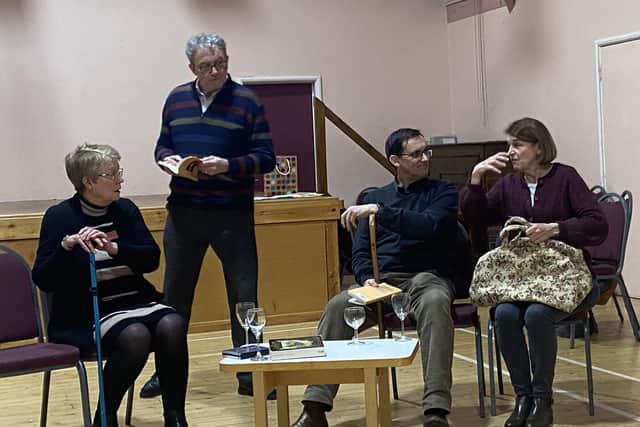
From left Jean Horton (played by Bridget Rowbottom), Reginald Paget (played by Alan Bullock), Wilfred Owen (played by Karl Bovenizer) and Cecily Robson (played by Janet Robinson)
Karl Bovenizer makes his first appearance and there are cameo roles for Dave Coghill and Lena Walsh: “Karl joined us and was our prompt at the last production,” added Sharon, “He has acting experience and we’ve had quite a few sessions talking about character development so that the cast don’t sound superficial.
We have tried to dig below the surface and think about what the characters are and Karl and the rest of the cast have been great.
Tickets for the play, which runs from Thursday, March 27 to Saturday, March 29, are available at the Chantry Tourist Information Centre, online at https://www.ticketsource.co.uk/whats-on?q=morpeth or alternatively pay on the door.
Buy your tickets now and join us for a beautiful and delightful play that is both funny and touching. It is full of wicked and saucy humour, about growing old and about art. It is a play of hope and confidence for people who in their retirement fear they may no longer have as much to offer. It is a play that loudly affirms, that us older people still have a zest for life and still have the same desires, needs and worries as we did when we were young, if not more!
Morpeth St George’s Community Players hoping new matinee performance will be a success
Morpeth St George’s Community Players tread the boards later this month when they unleash their spring offering ‘Quartet’ by Ronald Harwood.
However, in a milestone rejig, the committee behind the group have decided to axe what for years has been a traditional Saturday night finale performance in favour of a matinee on the same day.
Sue Rutherford, chair of the group, said: “Since Covid, things have changed with audiences and we are not alone. A lot of other groups have experienced the same thing and you have to adapt a little bit.
“We noticed of late that numbers for Saturday night audiences were dropping and for our last production – ‘Chase me up Farndale Avenue Si vous plait’ – our Saturday night attendance was particularly poorly attended.
“It was a chance remark I got from a friend who suggested would it be better if we did just a matinee performance on the Saturday, so I brought it up at our next committee meeting and we agreed that it was worth giving it a go.
“We will reassess it, but at the moment it will be for a trial of probably two years which means over four productions as we do two a year and the performance will start at 2pm.”
Sue added: “With the matinee it means that once the play is finished, we can tidy up and have a get-together and it frees the hall up on the Sunday for the church members.”
Tickets for the play, which runs from Thursday, March 27 to Saturday, March 29, are available at the Chantry Tourist Information Centre, online at www.ticketsource.co.uk or alternatively pay on the door.
Buy your tickets now and join us for a beautiful and delightful play that is both funny and touching. It is full of wicked and saucy humour, about growing old and about art. It is a play of hope and confidence for people who in their retirement fear they may no longer have as much to offer. It is a play that loudly affirms, that us older people still have a zest for life and still have the same desires, needs and worries as we did when we were young, if not more!









 St George's Community Players